
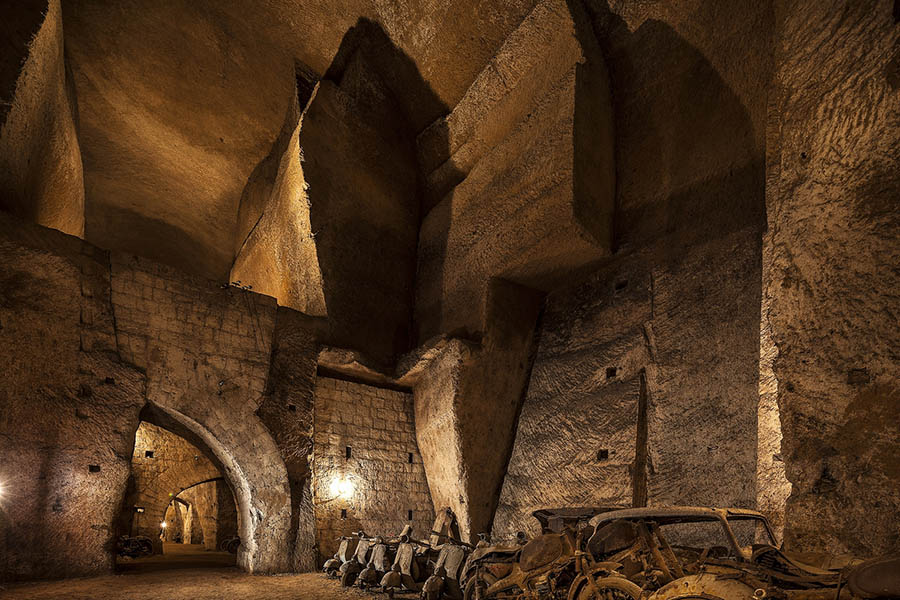
Beneath the vibrant, chaotic streets of Naples lies a secret, silent city waiting to be explored. The Naples underground is a vast, millennia-old labyrinth of tunnels, caverns, and chambers, offering a unique and fascinating journey through the city’s 2,400 years of history.
This subterranean world, carved into the soft yellow volcanic tuff that constitutes the local rock, tells a powerful story of human ingenuity, resilience, and evolution. From ancient engineering marvels to wartime refuges, exploring the Naples underground is a must for any visitor.
What is Naples underground?
The Naples underground is a network of underground spaces that stretches for hundreds of kilometres beneath the historic centre. Primarily, it consists of deep Naples underground caves created by the quarrying of tuff rock for construction, forming a honeycomb structure below the surface city.
This network also features ancient Naples underground aqueducts, vast cisterns, and natural fault lines. Today, the sites you can visit, such as the famous Napoli Sotterranea, allow visitors to delve 40 metres (130 feet) below ground, revealing layers of history directly beneath the modern city. This entire area is also connected to the broader Naples underground geothermal zone, linked to the volcanic nature of the region (Vesuvius and Campi Flegrei).
The history of Naples underground
The history of the underground city began around the 4th century B.C. when the ancient Greeks started digging beneath their newly founded city, Neapolis. They extracted the tuff stone to build city walls and temples, inadvertently creating the first underground chambers.
The Roman Empire later vastly expanded this network, developing a sophisticated system of Naples underground aqueducts and reservoirs to bring water from distant springs into the city’s homes and fountains. It’s a testament to ancient Roman engineering.
After centuries of disuse, these forgotten tunnels found a new, vital purpose during World War II. The underground chambers and reservoirs were quickly converted into air-raid shelters. Neapolitans would rush below ground at the sound of the siren, leaving behind graffiti, furniture, and personal objects that still offer a poignant glimpse into this tragic period of Naples underground history. More recently, parts of the network have been used for modern installations, including a scientific seismic station.
Naples underground: the path
When planning your visit, you’ll discover there are a few excellent options, each offering a distinct view into this hidden world.
- Napoli Sotterranea (Piazza San Gaetano): This is arguably the most famous and comprehensive tour. It typically lasts about 90 minutes and includes a descent to the Greek-Roman aqueducts, a look at the WWII air-raid shelters, and a visit to the remains of the ancient Roman Theatre hidden beneath a modern house. This is a highly recommended tour that answers the question: which Naples underground tour is best for a general overview.
- Galleria Borbonica (Bourbon Tunnel): Originally built in the 19th century as an escape route for King Ferdinand II of Bourbon, this site offers a fascinating look at the Bourbon era’s tunnels, vast chambers, and a collection of vehicles and relics from the period when it served as a judicial deposit and air-raid shelter.
- La Neapolis Sotterrata (San Lorenzo Maggiore): Located beneath the Basilica of San Lorenzo Maggiore, this site showcases the fascinating archaeological Naples underground ruins of the ancient Roman market (Macellum), allowing you to walk on the original Roman street level.
- Catacombs: For a different experience, explore the early Christian Naples underground catacombs of San Gennaro and San Gaudioso. These massive burial sites are a maze of corridors adorned with frescoes and mosaics, located in the Rione Sanità district.
While the Spanish Quarters are a vibrant area above ground, tours like the one starting from Piazza Trieste e Trento provide access to some of the ancient tunnel systems underneath the Naples underground Spanish Quarters.
Naples undergound: useful information
- How long is the Naples underground tour? The classic Napoli Sotterranea tour at Piazza San Gaetano usually lasts about 90 minutes. Other sites, such as the Catacombs, generally offer tours of about 60 minutes each.
- Tickets: It is always a good idea to book your tickets in advance, especially during peak season, to secure your spot and avoid long queues.
- Accessibility: Due to the narrow passages and numerous steps (often 136 down and 136 up for the main tour), most routes are not wheelchair accessible. Claustrophobic visitors should note that some optional sections of the main tours involve very narrow corridors, though there is usually an alternate route.
- Temperature: The temperature underground is consistently cool, between 15°C and 22°C (59°F and 72°F). A light sweater is recommended even in summer.
What is Naples underground known for today, apart from history? Some tunnels now host a small Naples underground museum or unique projects, like a geothermal pizzeria, showcasing the area’s ongoing connection to the volcanic subsoil.